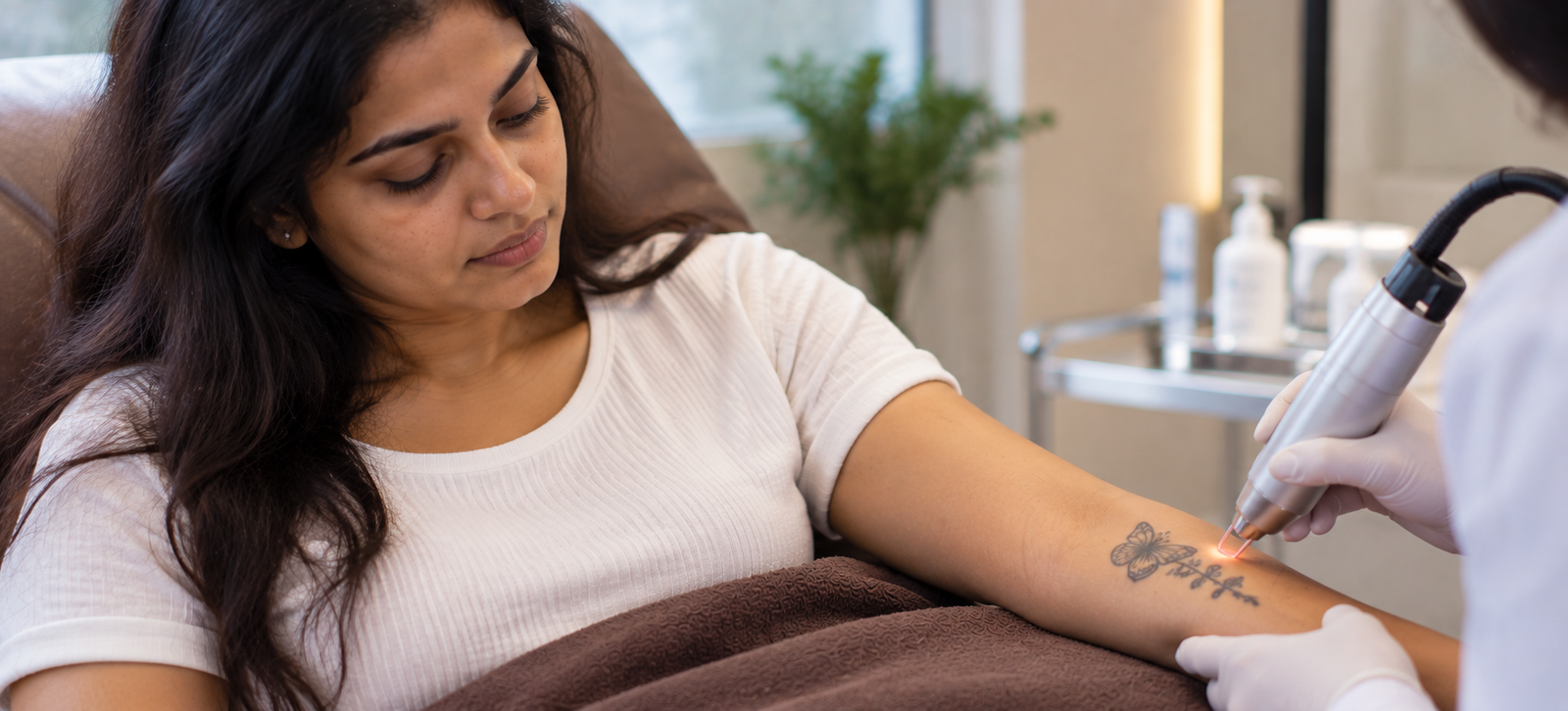
Permanent tattoos consist of insoluble ink granules deposited deep within the dermis-too large for your body’s immune cells (macrophages) to clear on their own
At DermiiZ Skin & Hair Clinic in Thillai Nagar, Trichy, our MD, DVL dermatologists perform Q-switched laser tattoo removal using rapid nanosecond photoacoustic pulses. These pulses fragment dense dermal ink into microscopic particles that your lymphatic system gradually clears between sessions, while wavelengths calibrated for Indian skin tones protect the surrounding tissue.
Types of Tattoos We Treat
Different ink colors, depths, and skin tones require specific laser wavelengths—such as 1064 nm for dark pigments and 532 nm for red tones—for safe, progressive fading.
Professional Multi-Colored Tattoos
Dense, machine-layered inks requiring wavelength-specific multi-color tattoo ink removal; black and dark blue respond fastest, while bright colors need additional sessions.
Amateur & Hand-Poked Tattoos
Typically carbon or India ink placed at varying dermal depths, clearing in fewer sessions.
Cosmetic Tattoos (Eyebrow / Lip Liner)
Targeted eyebrow tattoo removal laser protocols and lip-liner correction, beginning with a test spot to screen for iron-oxide pigment darkening.
Traumatic Tattoos (Gravel / Road Rash)
Foreign dirt or asphalt embedded beneath the skin following road accidents.
Benefits of Q-Switched Laser Tattoo Removal
Dermatologist-performed permanent tattoo removal in Trichy, calibrated to protect Indian skin tones and minimize textural or pigment risks.
Multi-wavelength targeting for dark black/blue inks and red or warm-toned pigments.
Cooled skin contact and topical anesthesia for optimal
procedural comfort.
Clean, progressive fading with each sequential laser
session.
Frequently Asked Questions About Laser Tattoo Removal
Answers from our dermatologists on session timelines, skin safety, cosmetic microblading removal, aftercare, and factors that determine tattoo removal cost in Trichy.
Most professional tattoos require 6 to 10 sessions (and occasionally more for dense, layered, or multi-colored inks), while superficial amateur tattoos often fade in 3 to 6 sessions. Treatments are spaced 6 to 8 weeks apart to allow your lymphatic system to clear fragmented ink and your skin barrier to heal. During your consultation at our Thillai Nagar clinic, our dermatologists assess your tattoo’s size, ink colors, depth, and body location to estimate both your expected session count and overall tattoo removal cost in Trichy. While dark inks often achieve near-complete clearance, some stubborn colors or deeply scarred tattoos may leave a faint outline.
When performed by a qualified dermatologist using appropriate fluences and a 1064 nm Q-switched Nd:YAG laser suited for Indian skin tones, permanent scarring is rare, and true keloids are uncommon unless you have a personal history of keloid formation. However, any existing scar tissue created when the tattoo was originally applied will remain visible after the ink fades, and temporary lightening (hypopigmentation) or darkening (hyperpigmentation) can occur while the skin heals. Inform your dermatologist before treatment if you have a history of keloids or raised scars.
Laser pulses feel similar to a warm rubber band snapping against the skin. To keep the procedure comfortable, we apply a medical-grade topical anesthetic cream (such as lidocaine/prilocaine) for 45 to 60 minutes before your session, paired with skin cooling during treatment. For highly sensitive areas, local injectable anesthesia can also be discussed with your dermatologist.
Yes, cosmetic tattoos can be treated with precision laser settings and protective eye or mucosal shielding, but they require special caution. Many eyebrow microblading and permanent lip-liner inks contain reddish-brown, flesh-toned, or white pigments made with iron oxide or titanium dioxide, which can temporarily turn darker (paradoxical darkening) when exposed to a Q-switched laser. Our dermatologists perform a small test spot first and wait 4 to 6 weeks to evaluate how the pigment responds before proceeding with full clearance.
Immediately after treatment, temporary redness, mild swelling, pinpoint crusting, or small blisters are normal as the skin heals. Keep the treated area clean, apply the prescribed soothing or antibiotic ointment for 7 to 14 days, and use a cool compress if the skin feels warm. Do not pick scabs or pop blisters, as doing so increases the risk of infection and scarring. Once the surface heals, protect the area from direct sunlight with opaque clothing or broad-spectrum SPF 50+ sunscreen for at least 3 months to prevent post-inflammatory pigmentation.