
Medical Alopecia Treatment in Trichy
Alopecia refers to a broad spectrum of medical hair loss disorders—ranging from reversible, coin-shaped autoimmune patches on the scalp or beard (alopecia areata) to inflammatory scarring conditions such as lichen planopilaris (LPP) and frontal fibrosing alopecia (FFA) that can permanently destroy hair follicles if left untreated.
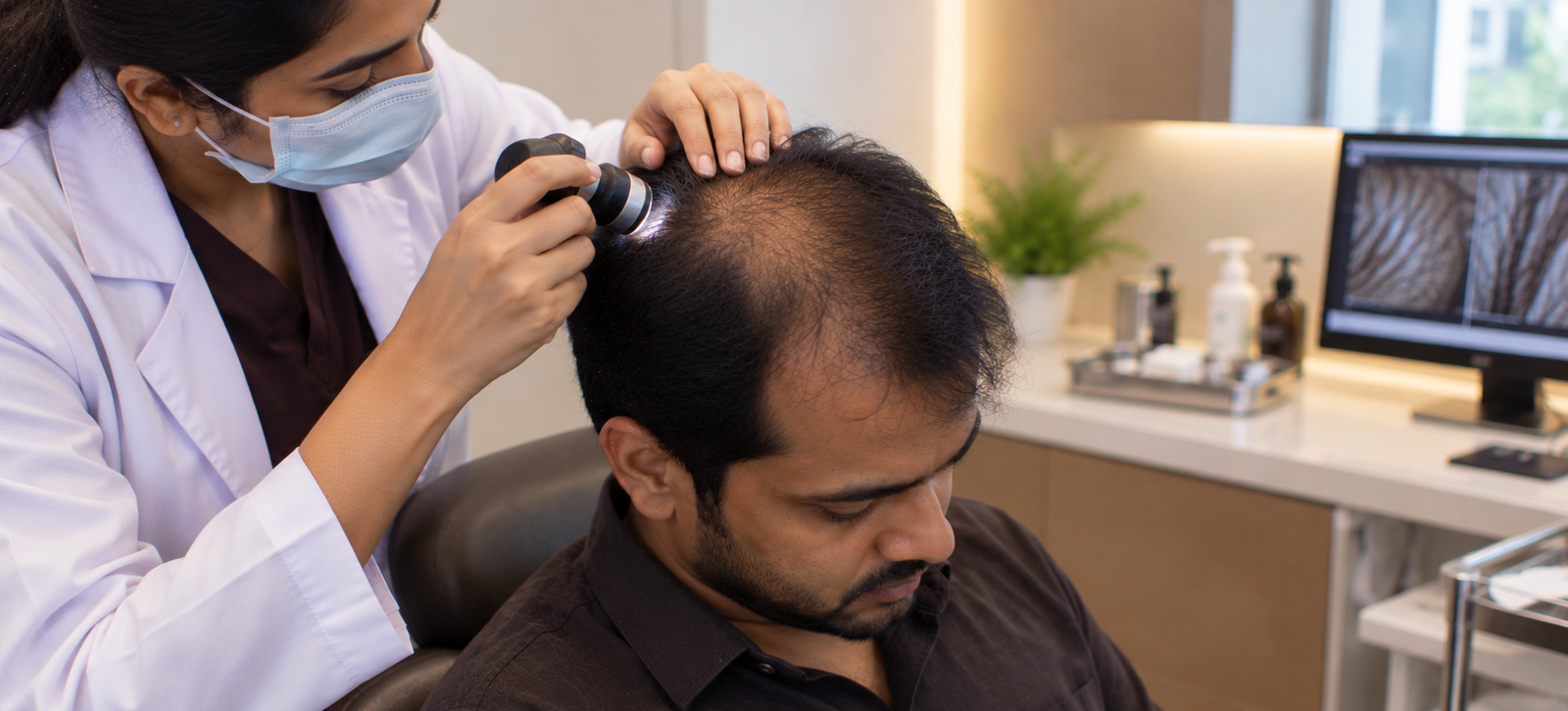
At DermiiZ Skin & Hair Clinic in Thillai Nagar, Trichy, Dr. M. Amrithaa (MD, DVL) and Dr. S. Shenbagaraj (MD, DVL) provide evidence-based alopecia treatment in Trichy. Through high-magnification digital trichoscopy—and scalp biopsy correlation when clinically indicated—we differentiate non-scarring from scarring hair loss early and initiate targeted immunomodulatory, anti-inflammatory, or regenerative care to protect your hair follicles.
Forms of Alopecia We Diagnose and Treat
Early dermatological diagnosis is essential to restart growth in non-scarring patches and halt permanent follicle loss in scarring disorders.
Alopecia Areata (Patchy Hair Loss)
Sudden, smooth round or oval bald patches on the scalp, beard, or eyebrows managed with targeted patchy hair loss treatment in Trichy.
Extensive Alopecia (Totalis & Universalis)
Widespread autoimmune hair loss across the entire scalp or body, managed with dermatologist-supervised systemic immunomodulators and regular monitoring.
Traction Alopecia
Hairline thinning caused by prolonged pull from tight braids, buns, or headgear, addressed with early traction alopecia treatment before scarring develops.
Cicatricial (Scarring) Alopecia
Inflammatory disorders such as lichen planopilaris (LPP) and frontal fibrosing alopecia (FFA) requiring prompt cicatricial scarring alopecia treatment to save remaining follicles.
Benefits of Dermatologist-Led Alopecia Care
Targeted immunomodulation and follicle-preserving medical protocols supervised by MD dermatologists.

Targeted Follicular Preservation & Regrowth
Calms autoimmune T-cell inflammation around the hair bulb to restore the growth cycle in non-scarring alopecia and halt progression in scarring forms.
High-resolution digital trichoscopy to track disease activity markers such as exclamation-mark hairs, yellow dots, and perifollicular scaling.
Precisely diluted intralesional corticosteroid micro-injections that target affected patches while minimizing skin thinning or systemic exposure.
Evidence-based systemic care and JAK-inhibitor therapy guidance with appropriate laboratory safety monitoring for extensive or resistant alopecia areata.
Frequently Asked Questions About Alopecia Treatment
Clear, dermatologist-verified answers to common questions about patchy hair loss, autoimmune alopecia, and scarring scalp disorders at our Thillai Nagar clinic.