
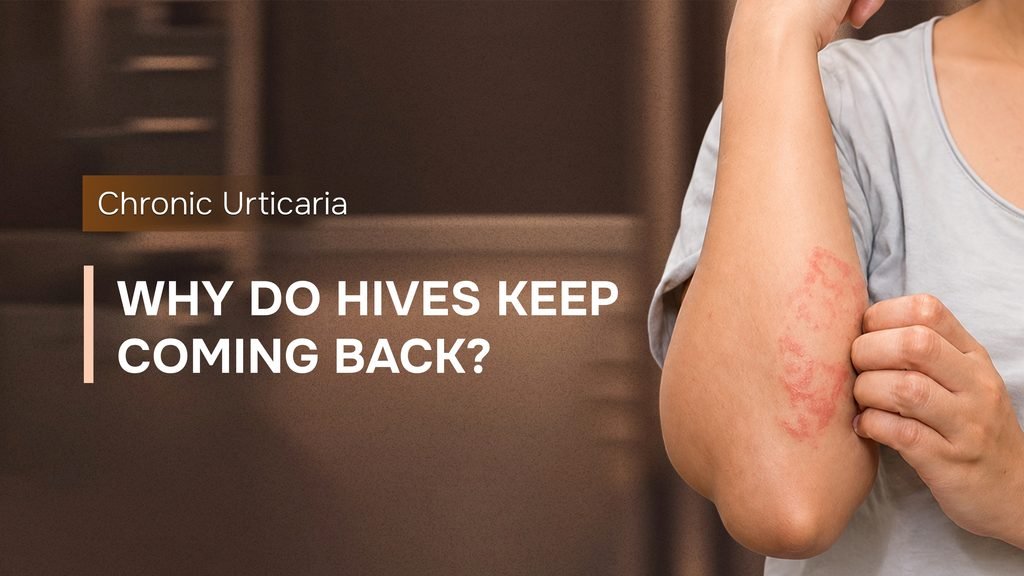
Have you noticed itchy, raised patches appearing on your skin, disappearing after a few hours, and returning somewhere else? Does this keep happening for weeks, even when you change your soap, food, or skincare products?
Repeated episodes of hives lasting more than six weeks may indicate chronic urticaria, a condition involving the release of inflammatory chemicals from immune cells in the skin. It can occur with or without an identifiable external trigger, and it is not always caused by an allergy.
One important detail often confuses patients: an individual hive usually disappears within 24 hours, but new ones can continue appearing for weeks or months.
Understanding why this happens, how dermatologists identify the underlying pattern, and which treatments are available can help you manage recurring symptoms more effectively.
What Is Chronic Urticaria?
Chronic urticaria is a skin condition in which itchy raised swellings, known as wheals, or deeper tissue swelling called angioedema occur repeatedly for more than six weeks.
According to the Indian Council of Medical Research (ICMR), the condition is classified as chronic when the episodes continue beyond this six-week threshold.
It is important to distinguish between the duration of the condition and the duration of an individual hive.
- An individual wheal generally disappears within a few minutes to 24 hours.
- New wheals may develop in different areas while older ones disappear.
- Angioedema affects deeper tissues and can take longer to settle, sometimes up to 72 hours.
- Symptoms may occur daily, almost daily, or intermittently.
This changing pattern is one of the characteristic features of chronic urticaria.
What Do Chronic Hives Look Like?
Hives do not look exactly the same in everyone. Their appearance can change depending on skin tone, the intensity of inflammation, and the stage of the episode.
Common features include:
- Raised, itchy patches that may be round, irregular, or map-shaped.
- Swellings that vary from a few millimetres to several centimetres.
- Skin-coloured, pink, reddish, or darker-looking raised areas.
- Patches that change shape or location during an episode.
- Swelling around the eyelids, lips, hands, or other body areas when angioedema occurs.
On darker Indian skin tones, redness may be less obvious. The raised texture and itching can be more noticeable than the colour change.
An important warning: If a particular rash remains fixed for more than 24 hours, becomes painful rather than itchy, or leaves bruising or persistent discolouration, it needs medical evaluation. Not every recurring rash is urticaria.
Two Main Types of Chronic Urticaria
Not all chronic hives develop for the same reason. Dermatologists generally classify the condition into two major categories.
| Feature | Chronic Spontaneous Urticaria (CSU) | Chronic Inducible Urticaria |
| Appearance | Recurrent hives without a definite external trigger | Hives following a particular stimulus |
| Main pattern | Episodes occur spontaneously | Episodes follow reproducible triggers |
| Common associations | Autoimmune mechanisms or an unknown cause | Heat, cold, pressure, friction or sweating |
| Predictability | Often difficult to predict | More predictable when the trigger is identified |
| Diagnosis | Clinical assessment and selected investigations | Clinical assessment and sometimes trigger-provocation testing |
Some people experience both types simultaneously. Identifying the correct subtype helps a dermatologist select an appropriate management approach.
1. Chronic Spontaneous Urticaria
Chronic spontaneous urticaria occurs when recurring hives develop without an identifiable, consistent external trigger.
It does not necessarily mean that the person is allergic to something.
In many cases, the immune system plays an important role. Immune-related mechanisms can activate mast cells, specialised immune cells that release histamine and other inflammatory mediators.
Histamine increases blood vessel permeability, allowing fluid to move into surrounding skin tissue. This produces the raised, itchy swellings associated with hives.
Although autoimmune mechanisms are important in chronic spontaneous urticaria, the exact underlying process is not identified in every patient.
2. Chronic Inducible Urticaria
Chronic inducible urticaria develops when specific physical or environmental stimuli repeatedly trigger symptoms.
Examples include:
- Heat-induced urticaria: Hives following exposure to local heat.
- Cold urticaria: Swelling or hives following cold exposure.
- Cholinergic urticaria: Small itchy wheals associated with increased body temperature, exercise, or sweating.
- Symptomatic dermographism: Raised itchy lines appearing after scratching or friction.
- Delayed pressure urticaria: Swelling developing several hours after sustained pressure, such as carrying a heavy bag.
- Solar urticaria: Hives triggered by exposure to particular wavelengths of light.
Hot and humid weather can make symptoms more noticeable in people sensitive to heat or sweating. However, humidity itself does not explain every case of chronic urticaria.
Why Do Hives Keep Returning Even Without an Allergy?
This is one of the most important questions patients ask.
Many people assume that recurring hives must be caused by a particular food, dust, detergent, or cosmetic product. However, chronic spontaneous urticaria is predominantly associated with immune-system mechanisms rather than a straightforward external allergy.
The 2026 international urticaria guideline specifically explains that a positive food-allergy test does not automatically establish that the food is causing chronic urticaria.
Several factors may be relevant.
Autoimmune Mechanisms
In some patients, the immune system produces antibodies that activate or influence mast cells and other inflammatory pathways.
This can lead to repeated histamine release without a consistent external allergen.
Physical Triggers
Heat, cold, pressure, scratching, sunlight, and physical activity may trigger particular forms of inducible urticaria.
Recognising a reproducible pattern is more useful than avoiding every possible environmental exposure.
Medications
Certain medicines can trigger or aggravate hives in susceptible individuals.
Non-steroidal anti-inflammatory drugs (NSAIDs), including some commonly used painkillers, may worsen chronic urticaria in some patients.
Do not discontinue prescribed medication independently. Discuss suspected reactions with your treating doctor.
Stress and Sleep Disruption
Stress does not explain every case of urticaria, but it can aggravate symptoms in some individuals.
Repeated night time itching may also interrupt sleep, creating an additional burden on everyday activities and quality of life.
Why Food Is Not Always the Answer
Food allergy can cause hives, particularly when symptoms repeatedly occur soon after consuming a specific food. However, an IgE-mediated food allergy is an uncommon underlying explanation for chronic spontaneous urticaria.
Avoiding milk, eggs, wheat, seafood, nuts, or other major food groups without a confirmed reason may create unnecessary dietary restrictions.
A dermatologist can help determine whether an allergy assessment is actually appropriate.
How Do Dermatologists Diagnose Chronic Urticaria?
Diagnosis involves understanding the history and pattern of symptoms rather than relying only on how the skin looks during an appointment.
Because individual hives can disappear within hours, the rash may not be visible when the patient visits the clinic.
1. Medical History and Symptom Assessment
Your dermatologist may ask:
- When did the first episode occur?
- How frequently do the hives appear?
- How long does each individual wheal remain?
- Do the patches move to different body areas?
- Does swelling occur around the lips or eyes?
- Do heat, exercise, cold, pressure, or sweating trigger symptoms?
- Are there any recent medication changes?
- Do the episodes affect sleep or daily activities?
A photograph of the rash during an episode can be particularly useful.
2. Physical Examination
The dermatologist evaluates the appearance and distribution of the swellings, associated angioedema, and any other skin changes.
This helps distinguish urticaria from conditions that may look similar but require different treatment.
3. Blood Investigations
Not every patient needs extensive allergy testing.
Depending on the clinical assessment, investigations may include:
| Investigation | Why it may be considered |
| Complete blood count | To identify relevant blood abnormalities |
| ESR or CRP | To assess signs of inflammation |
| Thyroid-related tests | When thyroid disease or autoimmunity is suspected |
| Total IgE and thyroid antibodies | May be considered during specialist assessment |
| Specific allergy tests | When the history suggests a genuine allergy |
The 2026 international guideline recommends a focused diagnostic approach, with additional investigations selected according to symptoms, medical history, and suspected associated conditions.
4. Trigger Assessment
When inducible urticaria is suspected, a dermatologist may perform controlled assessment or provocation testing to identify the relevant physical trigger.
For example, the evaluation may involve assessing skin responses to friction or temperature under medically appropriate conditions.
The objective is to identify the urticaria subtype and exclude other conditions, not simply to produce a list of possible allergies.
Treatment Options for Chronic Urticaria
Chronic urticaria treatment focuses on controlling symptoms, reducing flare-ups, improving sleep, and maintaining daily quality of life.
The appropriate treatment depends on symptom severity, response to previous medication, associated conditions, and the patient’s overall health.
1. Second-Generation Antihistamines
Second-generation H1 antihistamines are recommended as the first-line medication for urticaria.
They work by blocking histamine activity at H1 receptors, helping reduce itching and wheal formation.
Compared with older first-generation antihistamines, many second-generation options are less sedating.
For chronic spontaneous urticaria, doctors may recommend regular treatment rather than taking medication only after symptoms appear.
2. Specialist-Guided Antihistamine Dose Adjustment
Some patients continue experiencing hives even after taking standard doses of antihistamines.
In such situations, the 2026 international guideline supports increasing a single second-generation antihistamine to as much as four times its standard dose under an appropriate treatment plan.
This approach is off-label and must be managed by a qualified clinician. Patients should not increase their dose or combine different antihistamines independently.
3. Omalizumab for Antihistamine-Resistant Chronic Hives
When chronic spontaneous urticaria remains poorly controlled despite appropriate antihistamine treatment, a dermatologist may consider a biologic medicine called omalizumab.
Omalizumab is a monoclonal antibody that targets free immunoglobulin E (IgE), influencing pathways involved in mast-cell activation.
It is used as an add-on treatment for selected patients whose chronic spontaneous urticaria does not respond sufficiently to second-generation antihistamines.
The treatment is administered through injections under medical supervision. Its suitability, expected benefits, possible adverse effects, cost, and follow-up requirements should be discussed before starting.
Omalizumab is not necessary for every patient with chronic hives, and it should not be considered a guaranteed permanent cure.
4. Other Specialist-Directed Treatments
For severe cases that remain uncontrolled despite appropriate treatment, dermatologists may consider additional specialist-directed options.
Medicines such as ciclosporin may be considered in selected refractory cases, but their potential side effects and monitoring requirements make them unsuitable for unsupervised use.
Long-term systemic steroid treatment is generally discouraged because of the risk of significant adverse effects. Short courses may occasionally be considered for selected severe flare-ups under medical supervision.
Comparison of Treatment Approaches
| Treatment | Main role | Important consideration |
| Second-generation antihistamines | Initial symptom control | First-line treatment |
| Antihistamine dose adjustment | Persistent symptoms despite standard doses | Requires clinician supervision |
| Omalizumab | Selected antihistamine-resistant CSU | Specialist-administered biologic therapy |
| Ciclosporin | Selected severe refractory cases | Requires careful medical monitoring |
| Systemic corticosteroids | Limited rescue treatment in selected situations | Not recommended for long-term routine control |
What Can You Do at Home to Reduce Recurrent Hives?
Medical treatment remains important, but practical daily habits can help reduce aggravating factors.
Keep a Symptom Diary
Record the following information whenever hives develop:
- Time and date of the episode.
- Location and appearance of the wheals.
- How long each individual swelling remains.
- Possible physical or medication-related triggers.
- Associated lip, eyelid, or other swelling.
- Medication taken and symptom response.
Photographs taken during flare-ups can help your dermatologist understand the changing pattern.
Avoid Reproducible Physical Triggers
When a specific trigger has been identified, reducing exposure may help.
For example, people with pressure-induced symptoms may benefit from avoiding excessively tight clothing or prolonged pressure on affected areas.
Those with heat-related symptoms may find cooler surroundings and comfortable clothing helpful.
Avoid Excessive Scratching
Repeated scratching can increase skin irritation and aggravate symptoms.
Keep your fingernails short and consider a cool compress for temporary comfort.
Be Careful With Unnecessary Diet Restrictions
Do not eliminate several food groups simply because hives keep recurring.
A food restriction should be based on a convincing clinical history or an appropriately investigated allergy, not guesswork.
Follow the Prescribed Treatment Plan
Avoid repeatedly switching creams, using combination steroid creams, or taking additional antihistamines without medical advice.
Keep follow-up appointments so your dermatologist can assess disease control and adjust treatment when required.
When Should You Consult a Dermatologist?
Recurring hives deserve medical evaluation when:
- Symptoms continue for more than six weeks.
- Itching repeatedly interrupts sleep.
- Hives return despite standard treatment.
- Swelling develops around the lips, eyelids, hands, or other areas.
- A particular rash stays in the same place for more than 24 hours.
- The skin lesions become painful or leave bruising.
- Episodes interfere with work, exercise, or normal daily activities.
Medical emergency
Seek immediate emergency medical attention if hives are accompanied by difficulty breathing, throat or tongue swelling, difficulty swallowing, faintness, or signs of a severe allergic reaction. These symptoms may indicate anaphylaxis and require urgent treatment.
Can Chronic Urticaria Go Away Permanently?
Chronic urticaria does not follow the same timeline in every patient.
Some people experience gradual improvement, while others have recurring episodes over months or longer. Symptoms may also return after a period of complete remission.
The main treatment objective is to achieve good disease control and improve quality of life while the condition is active.
Regular follow-up allows the dermatologist to assess whether treatment is still necessary, adjust medication, and identify opportunities for reducing treatment when symptoms remain controlled.
The important point is that recurring hives are manageable medical symptoms. Persistent episodes should not be dismissed as ordinary skin irritation or treated indefinitely through self-medication.
Consult a Dermatologist for Recurrent Hives in Trichy
Recurring hives require more than temporary relief from itching. Identifying the type of urticaria, understanding possible aggravating factors, and selecting appropriate treatment can make a meaningful difference to everyday comfort and sleep.
At DermiiZ Skin and Hair Clinic, West Thillai Nagar, Tiruchirappalli, patients can seek dermatological assessment for persistent skin allergies and chronic urticaria.
Consultant dermatologists Dr. M. Amrithaa (MD, DVL) and Dr. S. Shenbagaraj (MD, DVL) provide skin and hair consultations.
Explore our Skin Allergy Treatment in Trichy and Skin Treatment Services for further information.
Clinic Address:
C83, 10th Cross Street, West Thillai Nagar, Tennur, Tiruchirappalli, Tamil Nadu – 620018.
Appointment Helpline: +91 86673 68838
Book a Dermatology Consultation at DermiiZ
Frequently Asked Questions
1. How long do hives need to last to be considered chronic urticaria?
Chronic urticaria is diagnosed when recurring wheals, angioedema, or both continue for more than six weeks. An individual hive usually disappears within 24 hours, but new swellings can develop elsewhere. The six-week definition refers to the overall pattern of recurring symptoms, not one continuous hive.
2. Can food allergies cause chronic urticaria?
Food allergies can cause hives, but they are an uncommon underlying cause of chronic spontaneous urticaria. Chronic symptoms are more frequently associated with immune-system mechanisms. Avoiding multiple foods without a confirmed relationship may be unnecessary. A dermatologist can determine whether specific allergy testing is appropriate.
3. Why do my hives disappear and appear in another area?
Individual wheals are temporary skin swellings caused by inflammatory mediator release, particularly histamine. As one swelling settles, new wheals may develop in different areas. This changing pattern is characteristic of urticaria. Photographing the episodes can help your dermatologist assess the condition.
4. Which tests are required to diagnose chronic urticaria?
Diagnosis mainly relies on medical history, physical examination, and the pattern of symptoms. Depending on the individual case, a dermatologist may recommend a complete blood count, inflammatory markers, or selected thyroid-related investigations. Extensive food-allergy panels are not routinely necessary for every patient.
5. What happens if antihistamines do not control chronic hives?
Your dermatologist may first review the diagnosis, medication adherence, and treatment dose. A specialist-guided increase in a second-generation antihistamine may be considered. For selected patients with persistent chronic spontaneous urticaria, omalizumab may be an additional treatment option. More resistant cases require individualised specialist assessment.